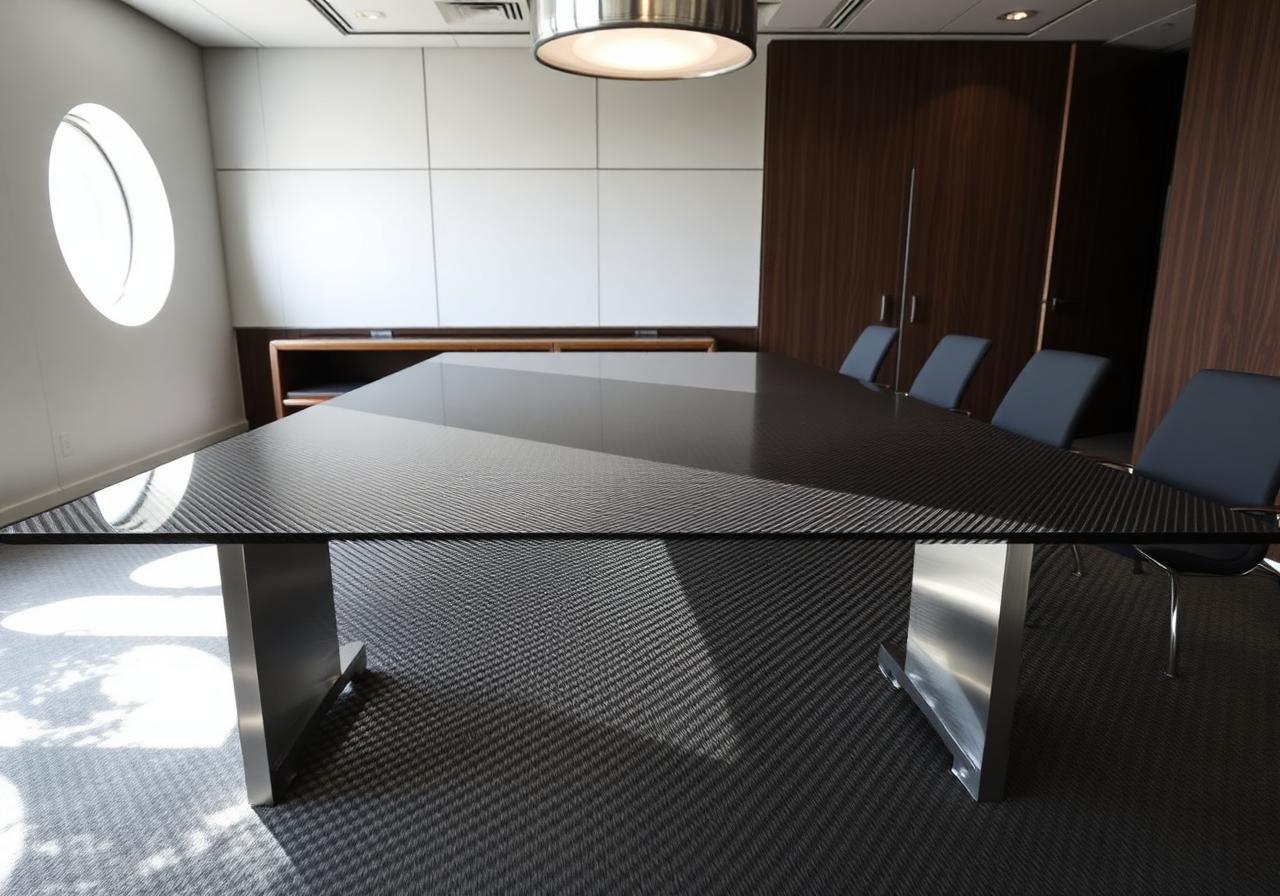
Tabletops woven from the same prepreg carbon laminate used in the 787 and A350 — light, rigid, and unmistakably aerospace.
How it's made
Layers of carbon fiber prepreg are laid in a mold and cured under heat and pressure in an autoclave, then trimmed and clear-coated. A 12-foot top can weigh under 40 pounds. The weave pattern — typically 2x2 twill or unidirectional — is left visible under the clear coat as both finish and proof of origin: a furniture-grade polyester or melamine surface would be both lighter and cheaper, but neither would read as aerospace.
Why executives like it
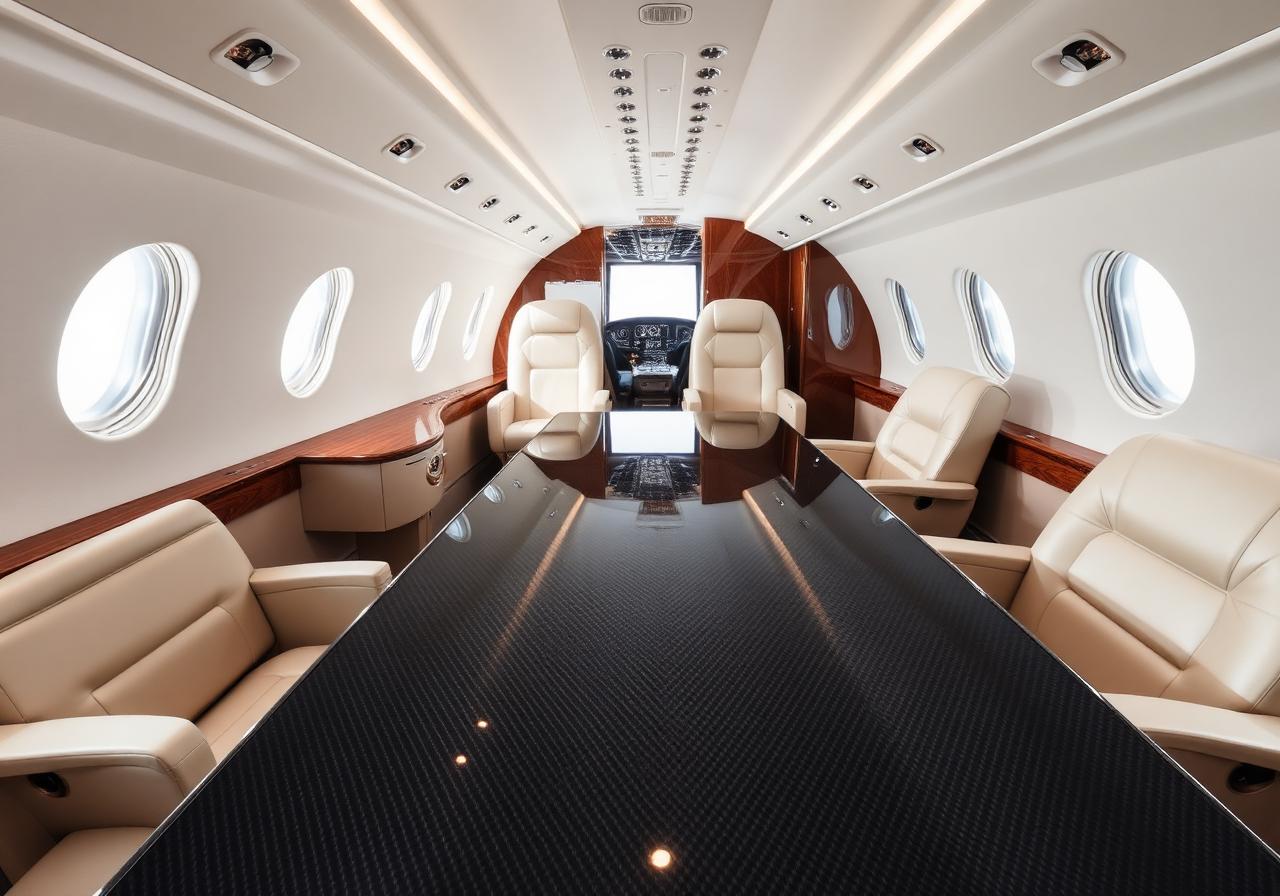
It quotes the airframe. For Gulfstream, Bombardier, and Emirates Executive, a carbon fiber boardroom table is brand identity rendered as furniture. The material does the work of a brochure: a client sitting at a Gulfstream G700 mock-up table is being told, before anyone speaks, that the company knows how to handle composites and that the cabin floor will share the same DNA as the boardroom.
The weight illusion
A signature party trick at aviation trade shows: a sales engineer lifts the entire conference table with one hand. A 12-foot solid-wood boardroom table can weigh over 400 pounds; the carbon equivalent rarely exceeds 50. The performance is theater, but the underlying physics is the same that lets a 787 wing flex up nine feet in turbulence without permanent deformation — and the demonstration sells widebodies as efficiently as it sells tables.
The unsolved repair problem
Carbon laminate is famously difficult to refinish. A scratched mahogany top can be sanded and re-oiled by a competent woodworker; a scratched carbon top must usually be returned to a composite shop, vacuum-bagged, and re-cured, often at a cost approaching the original price. Most aviation operators simply replace damaged tops outright — a maintenance economics inherited directly from how composite aircraft components are handled in the field.
Beyond the boardroom
Most carbon-laminate furniture for aviation is now produced as a sideline by composite shops in Wichita, Toulouse, and Nagoya — the same suppliers cutting interior panels for business jets. The tabletop and the cabin trim often come off the same autoclave shift.
From the archive

Belongs to the era of
1990s–Present · The Digital Cockpit →More from the catalogue