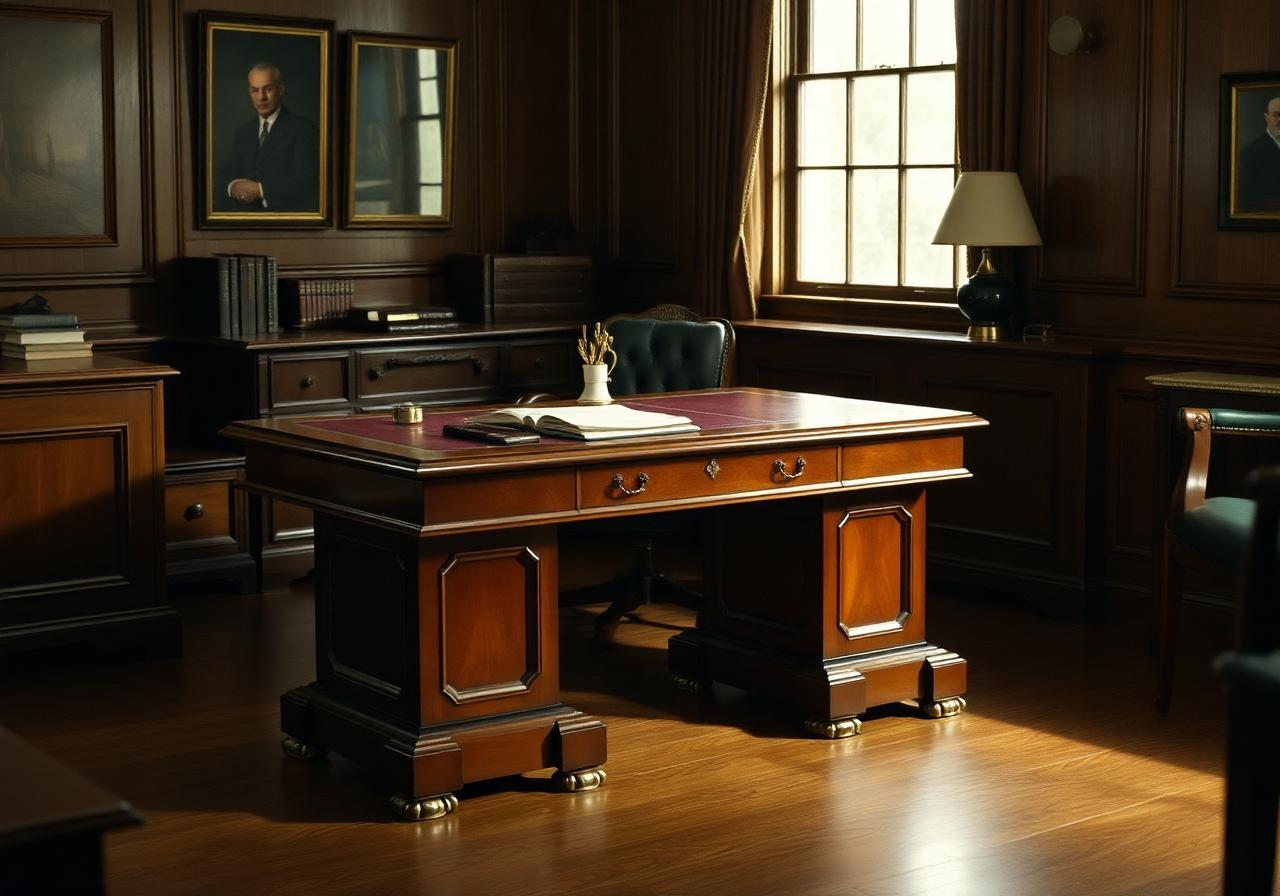
A twin-pedestal mahogany desk, often weighing more than 600 pounds, that became the throne of every postwar airline founder.
Construction
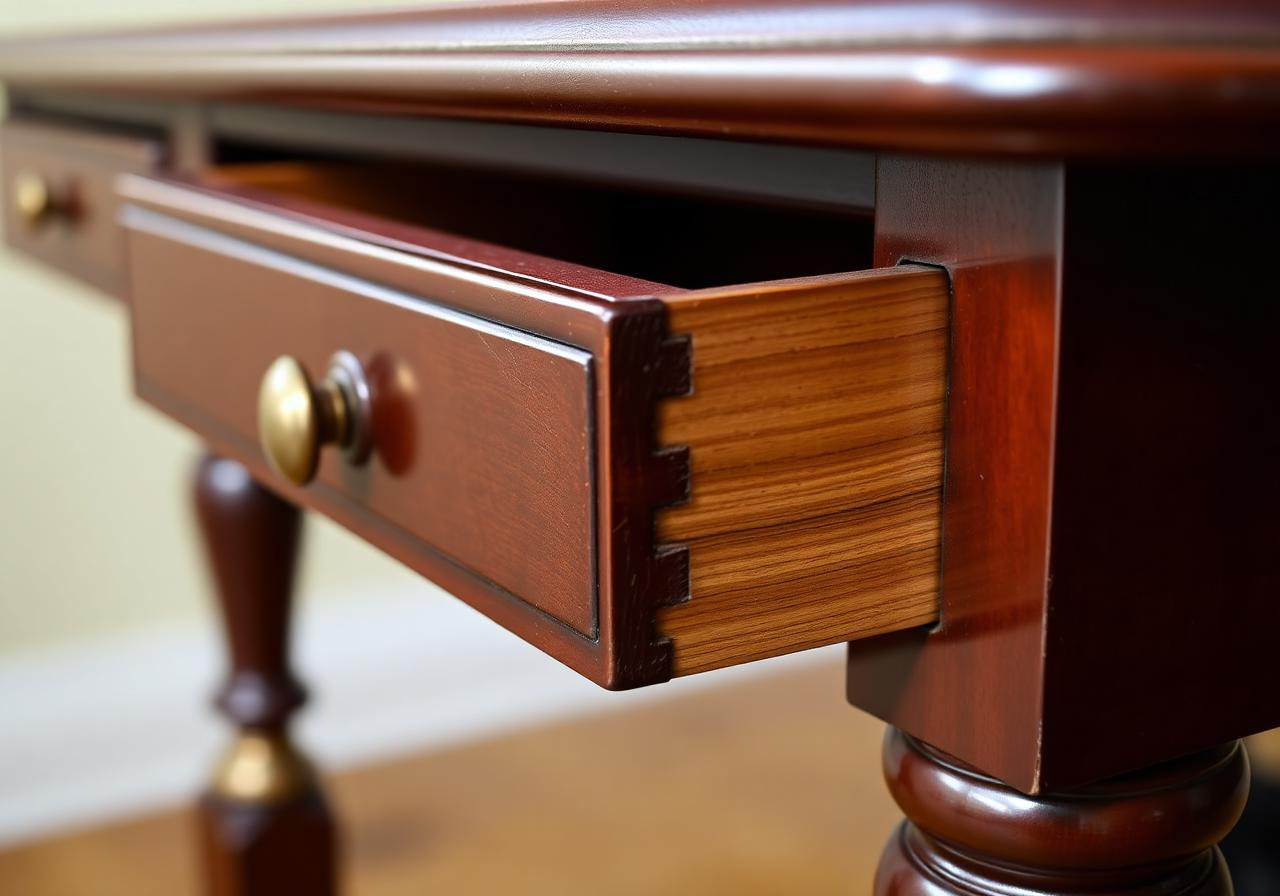
Solid Cuban or Honduran mahogany over an oak carcass, with hand-cut dovetails, brass cup castors, and a tooled-leather writing surface dyed oxblood or forest green. The twin-pedestal form — two banks of drawers facing each other across a shared kneehole — was originally designed so a senior partner and a junior could work eye-to-eye, a hierarchy disguised as collaboration.
Why aviation chose it
Airlines were a young, volatile industry — and their executives borrowed the visual language of banking and shipping to look permanent. Juan Trippe at Pan Am and C.R. Smith at American both worked from partner desks well into the jet age. Photographs from Pan Am's Chrysler Building offices in the 1950s show Trippe behind a near-identical desk in nearly every published portrait — a deliberate piece of staging that said the airline was as old as its furniture.
The weight problem
A finished partner desk routinely exceeded 600 pounds. Moving one between floors of the Pan Am Building required four men, a freight elevator, and protective blankets — and that physical inconvenience was part of the point. A desk you could not casually rearrange was a desk that announced the office, and its occupant, were not going anywhere.
Wood politics
Cuban mahogany (Swietenia mahagoni) was effectively logged out by the late 1940s; the 1962 trade embargo finished what remained. Postwar examples shifted to Honduran mahogany (Swietenia macrophylla), and by the 1980s most surviving stocks moved under CITES Appendix II controls. A genuine pre-war Cuban-mahogany partner desk is now both a furniture object and a small ecological artifact — its provenance documented as carefully as a vintage aircraft's.
Quiet survival
Most surviving examples are now in private aviation lounges or restored as auction lots — a Pan Am-provenance partner desk sold at Bonhams in 2019 for over £40,000. The form refuses to die because it still says, more clearly than any modern alternative, 'this institution intends to outlive you.'
From the archive

Belongs to the era of
1940s–1950s · Mahogany & Leather →Manufactured by
Maple & Co. →More from the catalogue