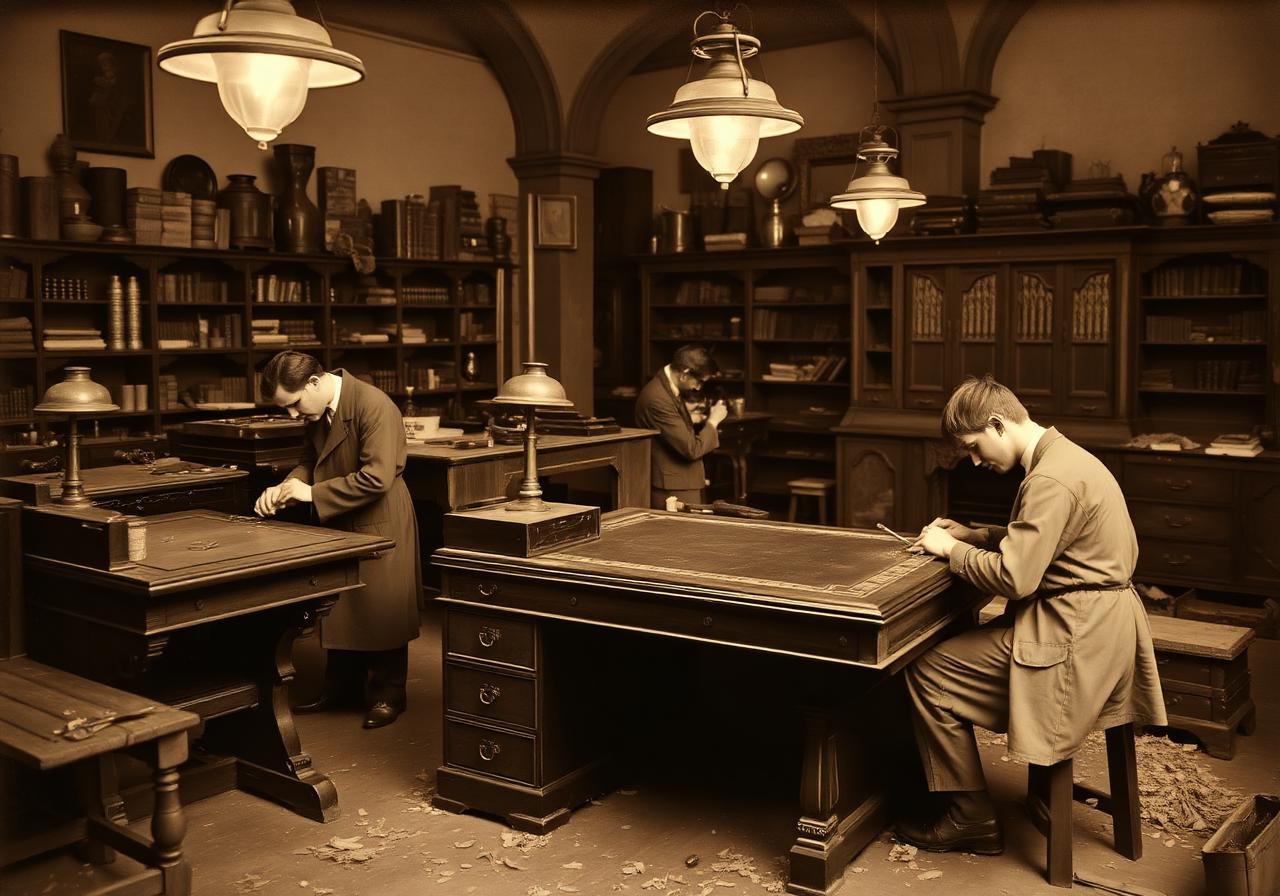
The Victorian workshops whose mahogany partner desks and Chesterfield seating set the visual grammar of executive power for a century.
The cabinetmaker as institution
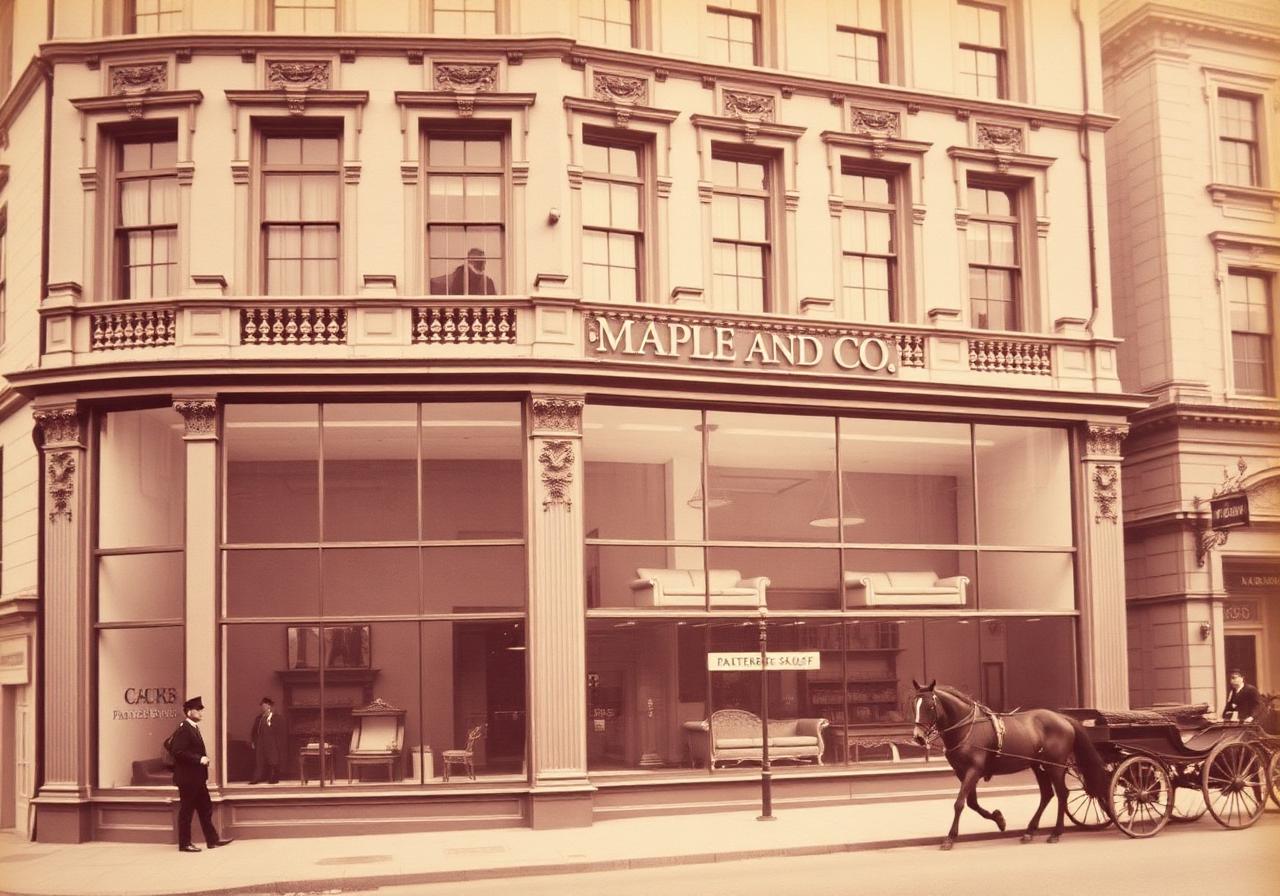
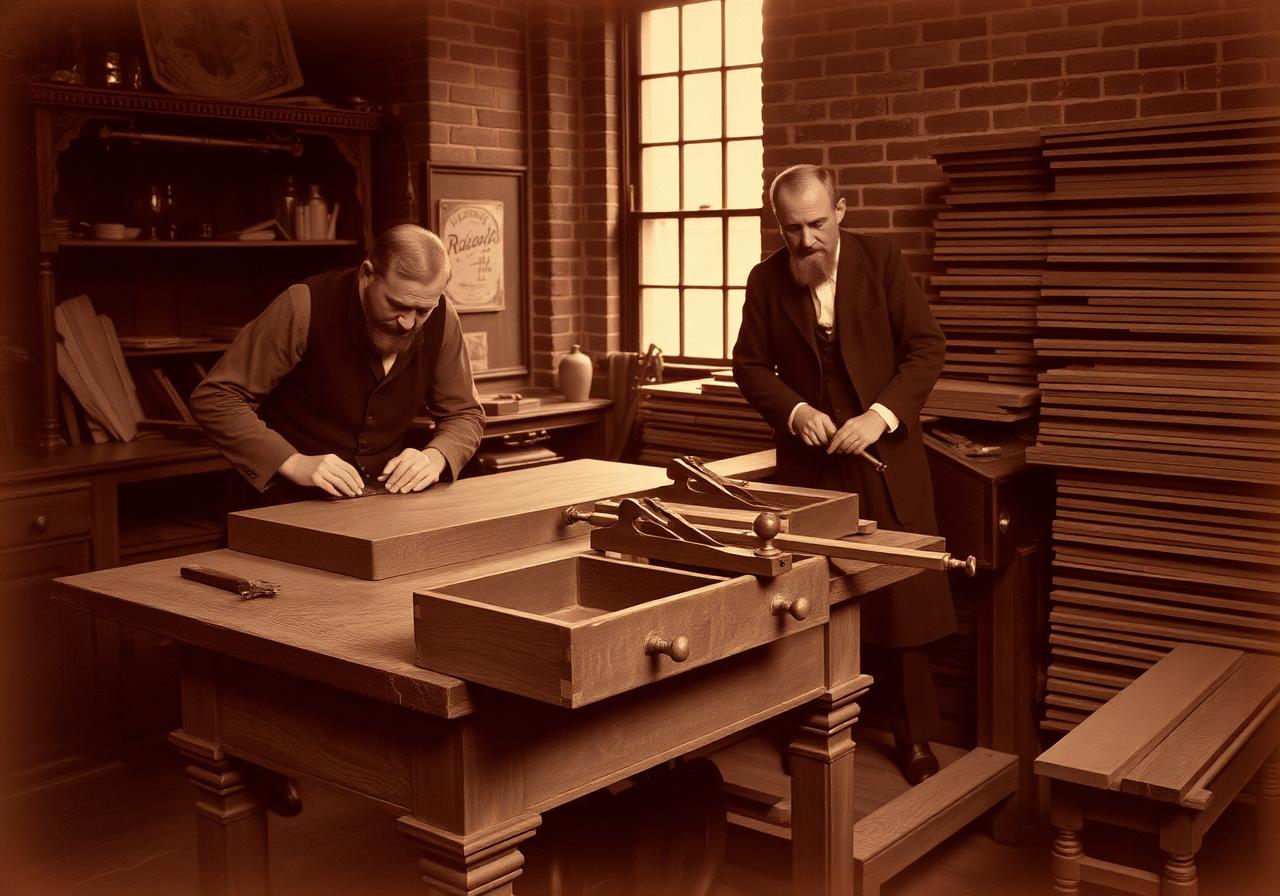
Maple & Co., founded on Tottenham Court Road in 1841 by John Maple and James Cook, grew from a modest drapery into the largest furniture house in the world by the 1890s, with workshops employing over 2,000 craftsmen and a catalogue running to nearly a thousand pages. Alongside Gillows of Lancaster, Holland & Sons, Howard & Sons, and Heal's, it supplied the studies and boardrooms of British banking, shipping, and government from the 1850s onward, holding royal warrants from Queen Victoria, Edward VII, and George V. Their hand-cut dovetails, oxblood leather tops, and brass cup castors were the visual proof that an institution intended to last — and the firm's invoices to the Bank of England, P&O, the Foreign Office, and Lloyd's of London survive as a kind of map of late-Victorian power.
How aviation borrowed the language
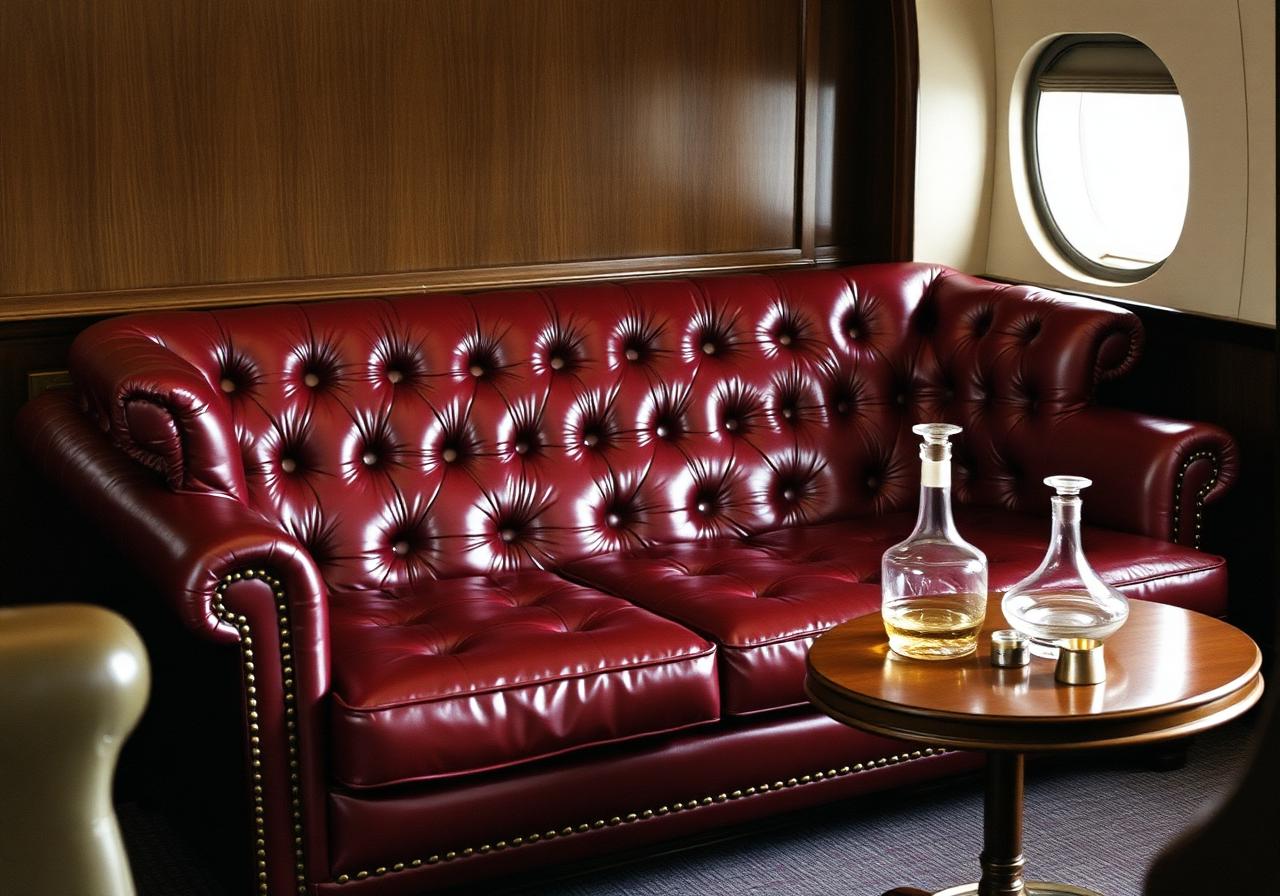
When Pan Am, TWA, Imperial Airways, and KLM furnished their first executive offices in the 1930s and 40s, they reached for these forms — partly out of conviction, partly out of marketing strategy. Juan Trippe at Pan Am had Maple & Co. ship a complete suite of mahogany furniture to the Chrysler Building in 1934; Imperial Airways' Croydon offices were furnished entirely from the Maple catalogue. American copyists in Grand Rapids — Berkey & Gay, Widdicomb, John Widdicomb Co. — reproduced English partner desks at scale through the 1940s, and Chesterfield sofas crossed the Atlantic by the container, often arriving on the same Pan Am clippers whose offices they would furnish. The young aviation industry literally bought legitimacy by the pound.
Quiet survival
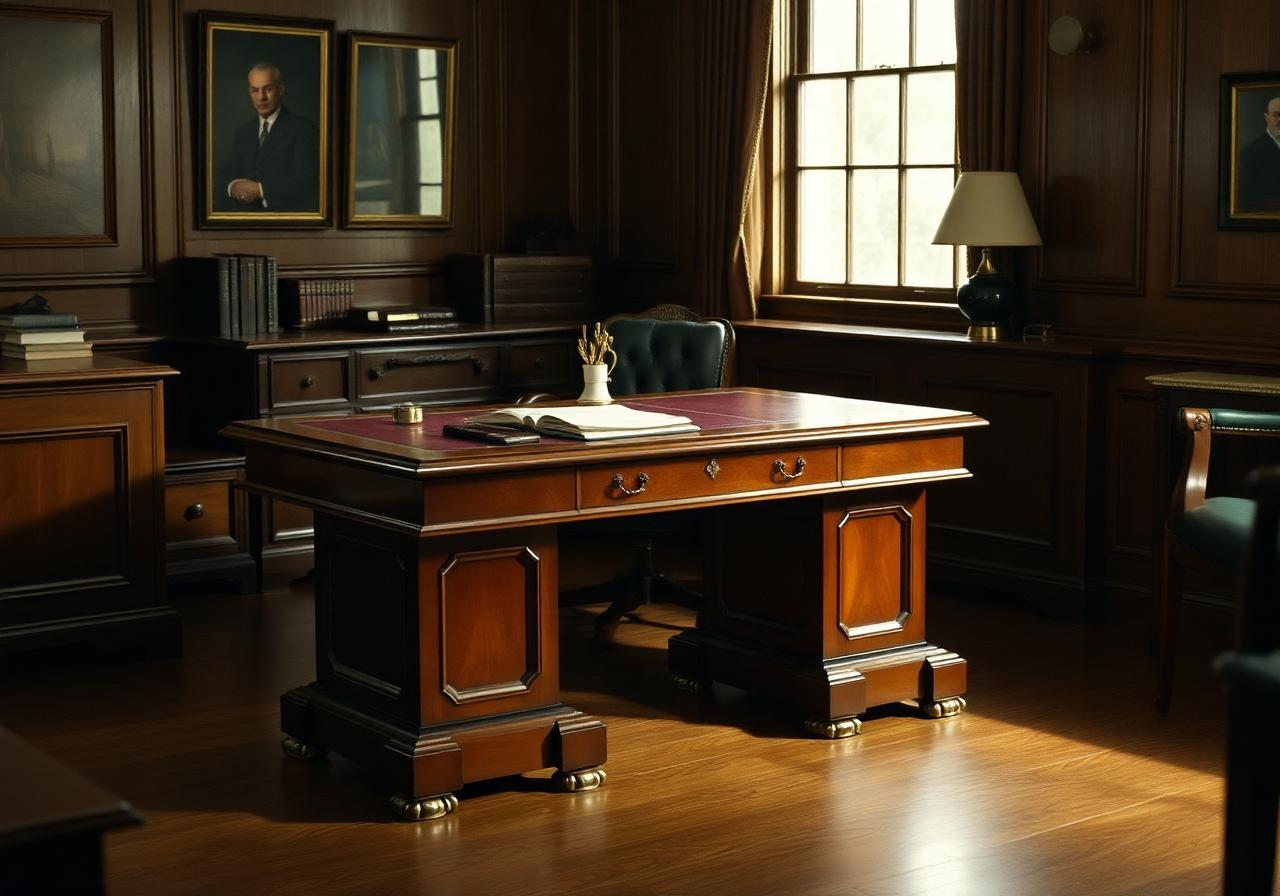
Maple & Co. itself closed its Tottenham Court Road premises in 1997, after a long decline through the 1970s and 80s as British retail furniture moved decisively downmarket. The form it perfected has not closed with it. Restored Victorian partner desks still appear in the offices of legacy airline chairmen and in private aviation lounges from London to Singapore — Cathay Pacific's Hong Kong offices, BA's Heathrow boardroom, the chairman's suite at Singapore Airlines all retain Maple-era pieces, often acquired at auction from law firms and merchant banks dispersing their estates. They are a 19th-century answer to a 21st-century question about authority, and the answer has not improved with substitution.
An anonymous trade
Unlike Saarinen, the Eameses, or Stumpf and Chadwick, the bench hands at Maple & Co., Gillows, and Holland & Sons were never named. Their work survives in auction catalogues attributed to the firm — sometimes to a foreman, almost never to the maker — and what we know of their training comes mostly from apprenticeship records held in the V&A and the Museum of London. A first-class cabinetmaker at Maple in 1885 would have served a seven-year apprenticeship, signed no piece, and earned roughly £2 a week. It is perhaps the truest measure of the form's authority: the chair is the institution, not the artist, and the institution outlived nearly all of them.
Pieces by this designer
Belongs to the era of
1940s–1950s · Mahogany & Leather →Manufactured by
More designers