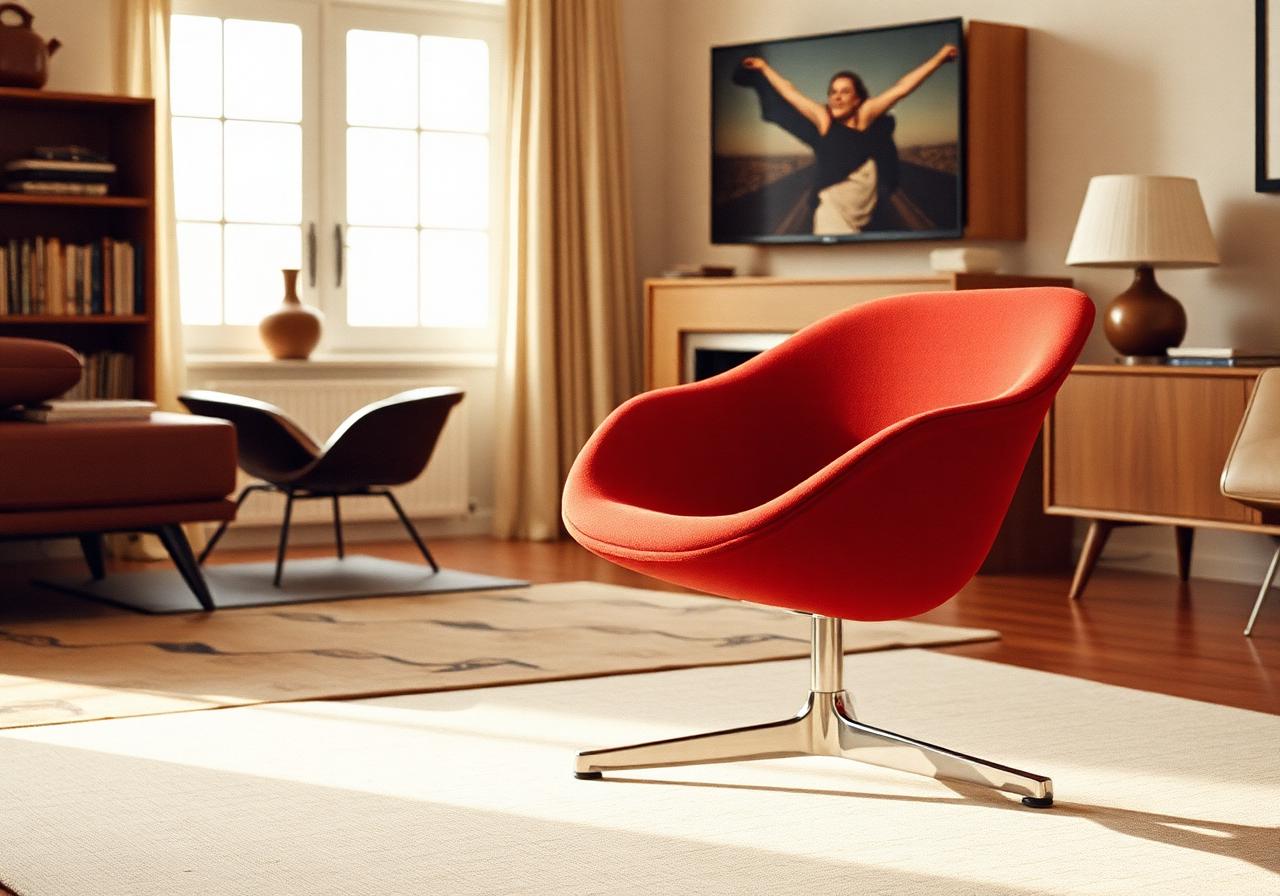
The chair Florence Knoll commissioned because she 'wanted a chair that was like a basket full of pillows — something I could really curl up in.'
A specific brief
Florence Knoll, then head of Knoll's Planning Unit and the most influential interior designer working in postwar America, gave Saarinen a one-sentence brief in 1946: design a chair she could curl up in. He delivered the Womb (model 70) two years later — a fiberglass-reinforced shell sprayed with foam latex, upholstered in wool, and slung on a tubular chrome-steel base. It was one of the first commercial uses of fiberglass in a chair, and the manufacturing process had to be invented largely from scratch. Boatbuilders on Long Island, more familiar with fiberglass than any furniture factory, were contracted to mold the first production shells.
The seated posture problem
Saarinen had argued for years that the standard upright chair forced an unnatural posture on the sitter — that 'people sit differently today than in the Victorian era; they want to slouch.' The Womb was his answer: an enveloping shell that supported the body in any of a dozen positions, including ones polite Victorian seating had been designed specifically to prevent. It became the favorite reading chair of architects, including Saarinen himself, who kept one in his Bloomfield Hills office.
In airline lounges
First-class lounges at Idlewild (later JFK) and at TWA's St. Louis hub installed Womb chairs in the early 1960s — softer, less formally hierarchical seating for the long pre-boarding waits the early jet age imposed. Pan Am's Worldport lounge kept a pair near the picture windows facing the ramp; the chairs survived in service until the terminal's renovation in 1991.
Continuous production
Knoll has manufactured the Womb continuously since 1948 — over 75 years, with the original tooling still in use for the shell. The base was switched from chrome to polished steel in the 1970s and back to chrome in 2002 at the insistence of collectors. A current Womb chair retails at approximately $5,800; vintage examples in original Knoll Cato wool routinely exceed that at auction.
From the archive
Belongs to the era of
1940s–1950s · Mahogany & Leather →Manufactured by
Knoll →More from the catalogue