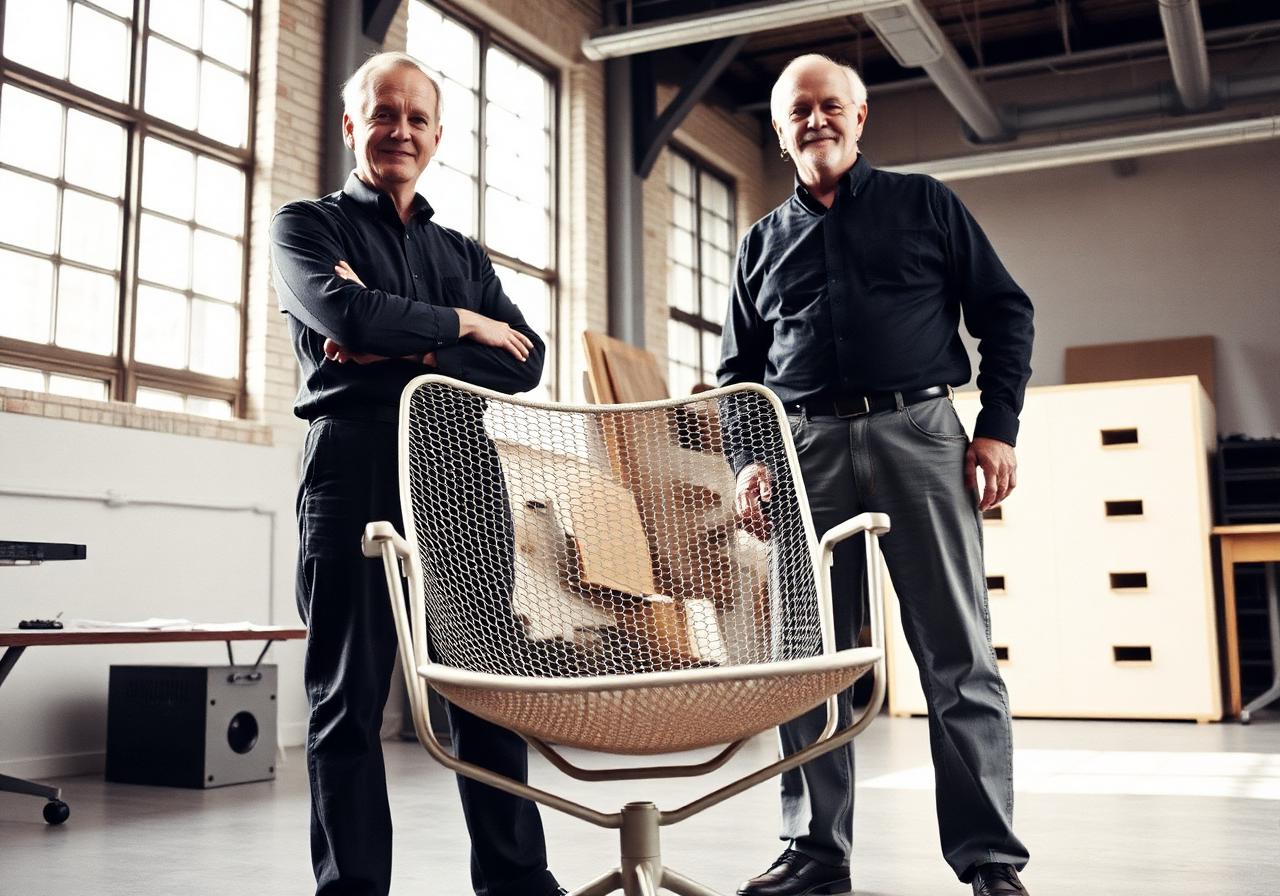
The designers who replaced the leather throne with mesh — and made ergonomics a credible language of executive power.
An ergonomic argument
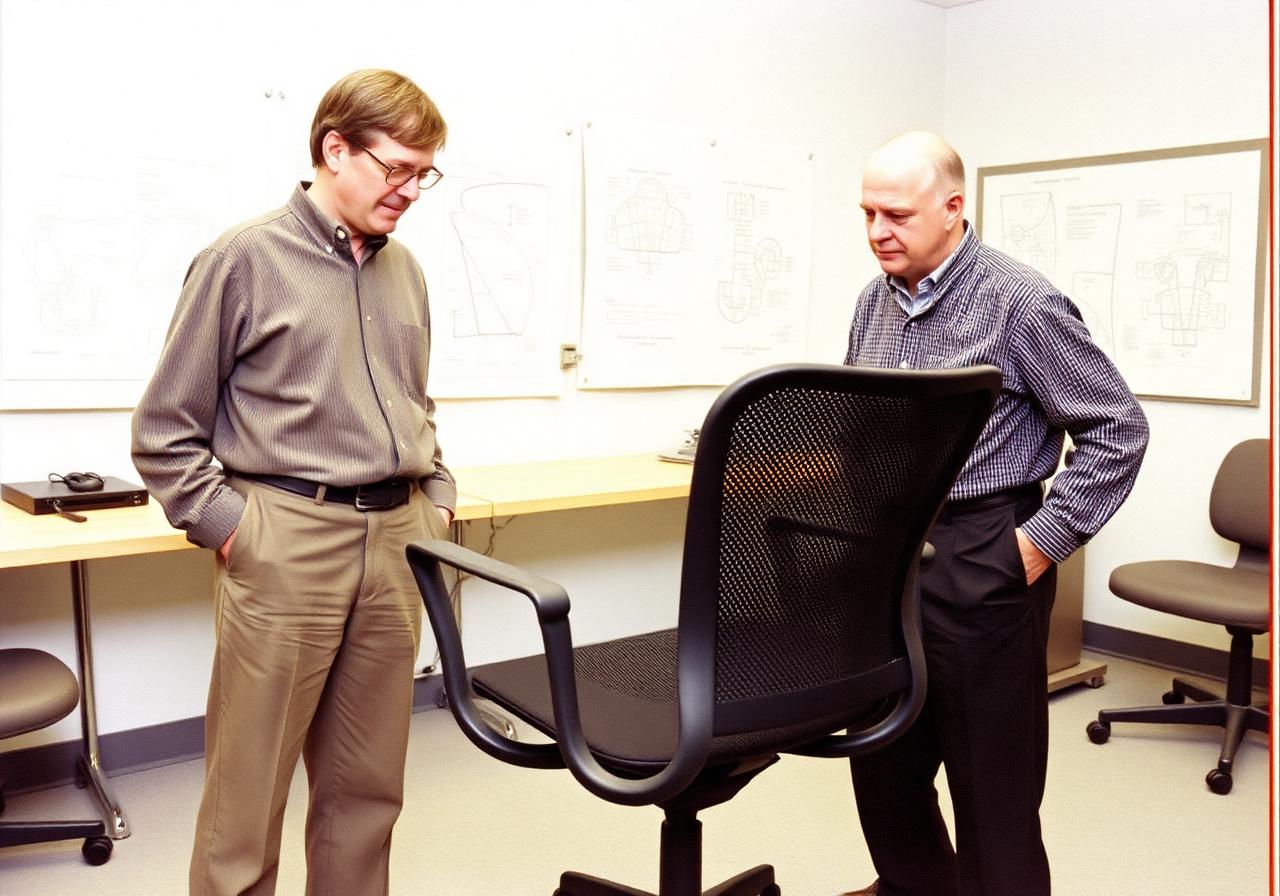
Stumpf, an industrial designer with a background in environmental design from the University of Wisconsin, had spent the 1970s at Herman Miller's Research Corporation studying how bodies actually sit — work that produced the 1976 Ergon chair, the first mass-market chair designed around posture data rather than reception-room aesthetics. Chadwick, based in Los Angeles, had built a parallel career around the engineering of molded plastics, including the early Modular Seating system for Herman Miller. The two had collaborated on the 1984 Equa chair before Herman Miller asked them, in 1986, to design a chair specifically for older users in domestic settings. That brief mutated, over eight years and more than seventy prototypes, into the 1994 Aeron — the first chair to abandon foam and upholstery in favor of a woven elastomeric mesh stretched over a sculpted glass-reinforced polymer frame.
A new look for the corner office
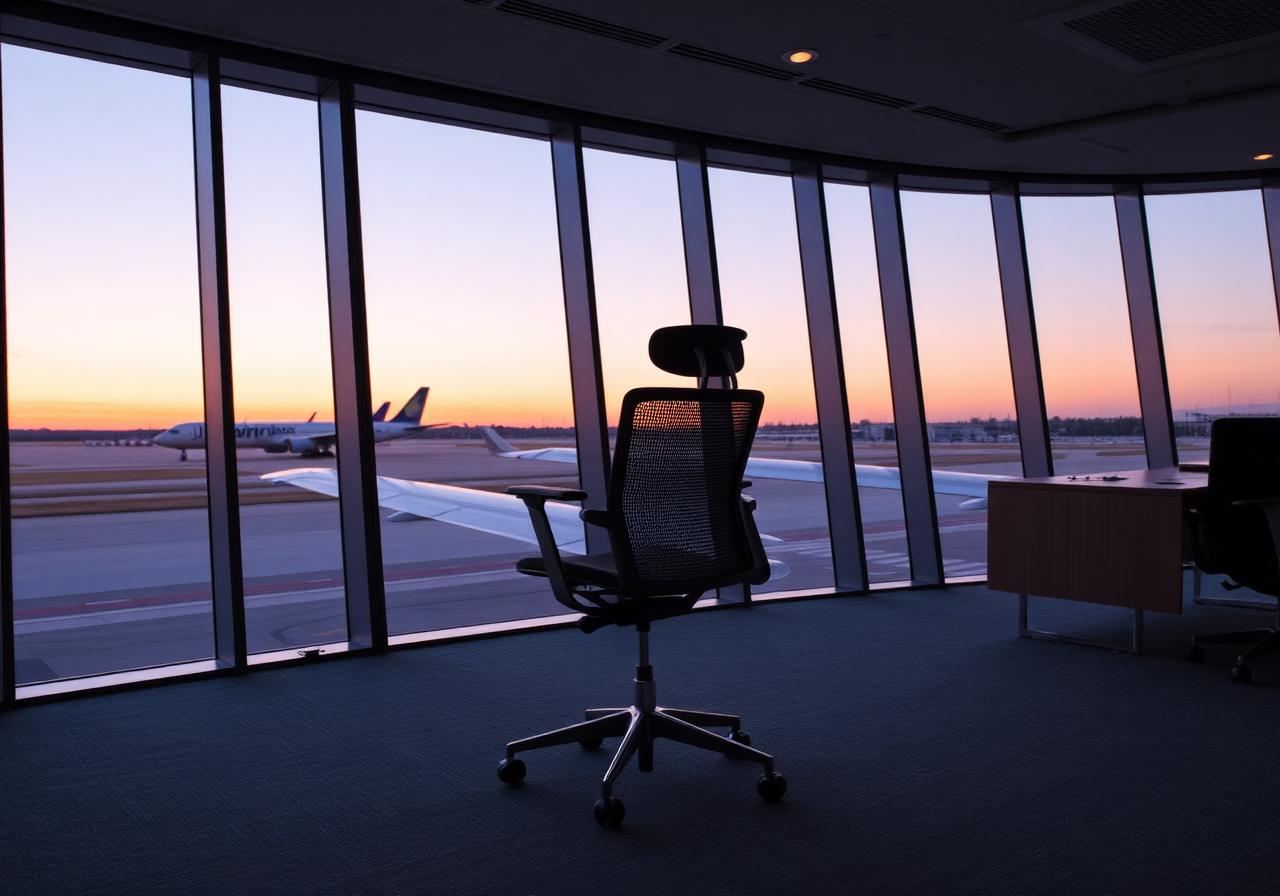
Until Aeron, executive seating meant leather. Stumpf and Chadwick's exposed structure and visible mesh argued the opposite case: that authority could be communicated through engineering legibility — visible mechanism, exposed material, no upholstery to soften or hide what the chair actually did — rather than through ornament. Early reviewers, including Herman Miller's own focus groups, found it unsettling, even ugly; the chair sold sluggishly for its first eighteen months. By 2000 it was standard at Boeing, Airbus, FedEx, and most major airline headquarters, and by 2005 it had effectively retired the leather throne as the default executive chair across North America. The MoMA acquired one for its permanent collection in 1992 — two years before the chair was even released to the public.
Three sizes, one chair
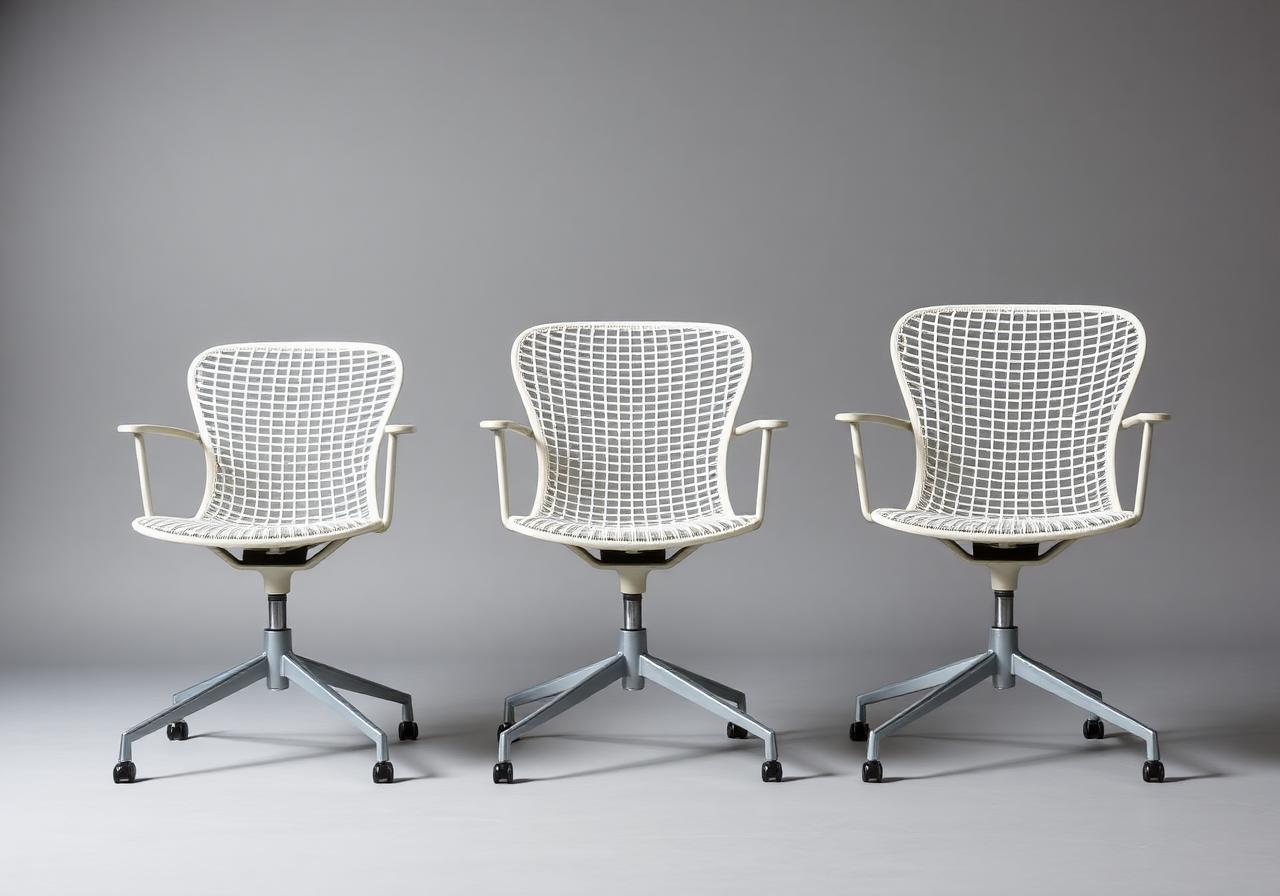
Aeron shipped in A, B, and C frame sizes — sized to roughly the 5th, 50th, and 95th percentiles of adult body dimensions — a deliberate rejection of the 'one chair fits everyone' premise of executive seating. Stumpf, who had grown up watching his father struggle with rheumatoid arthritis, insisted that fit was not a luxury option but the entire brief: a chair that fit 95% of users badly was a worse chair than three chairs that fit 95% of users well. Herman Miller's sales force initially resisted — three SKUs is harder to sell than one — but the data on long-term customer satisfaction settled the argument within a year.
Museum and beyond
The Museum of Modern Art acquired an Aeron for its permanent collection in 1992. The chair has been continuously refined — most substantively in the 2016 Remastered edition, with a new 8Z Pellicle weave, redesigned PostureFit SL lumbar, and a longer tilt arc — but its design intent has not changed: the body is the brief. Stumpf died in 2006; Chadwick continues to consult on the chair's evolution from his Los Angeles studio. The Aeron has now sold over eight million units, more than any other office chair in history, and remains the only piece of furniture most people can name by its designer.
Pieces by this designer
Belongs to the era of
1990s–Present · The Digital Cockpit →Manufactured by
More designers