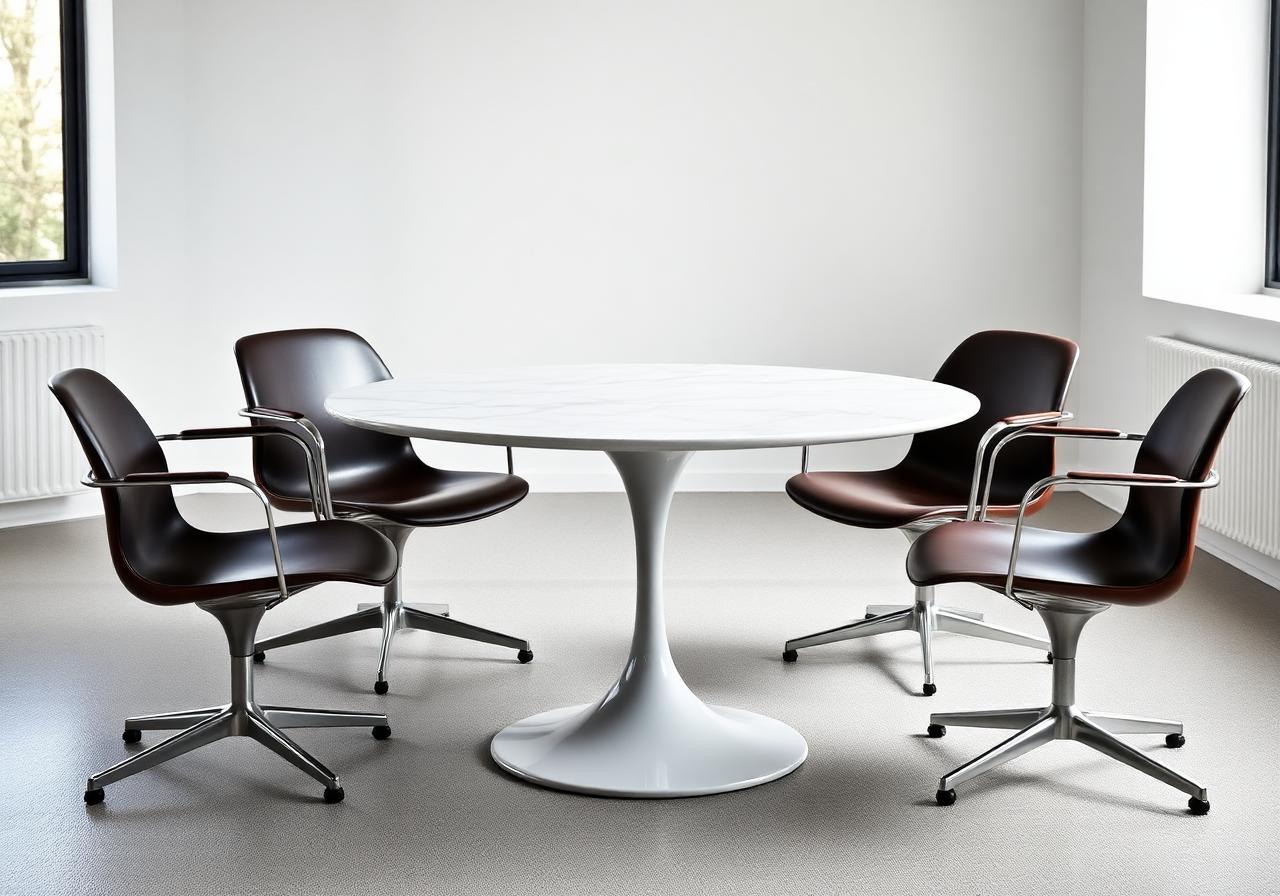
The conference-room companion to the Tulip chair — a single cast-aluminum stem holding a marble top, completing Saarinen's campaign against the slum of legs.
A matched set
The Pedestal Table was designed in parallel with the Tulip Chair as part of the same 1957 Pedestal Collection. Saarinen's intent was that the chair and the table should read as a single visual idea — one stem from the floor in each case, no legs to confuse the eye. The round and oval tops came in marble (Carrara, Arabescato, Calacatta), in laminate, and later in granite; the stem in every case was the same sand-cast aluminum, powder-coated white.
Engineering the marble
A 54-inch round Carrara top weighs roughly 280 pounds. Holding that mass on a single stem required Knoll's engineers to develop a steel reinforcing core hidden inside the aluminum casting — without it, the cantilever would have failed under any sideways load. The result is a table that looks impossibly light from above and sits with the dead weight of a small car at floor level: an effect Saarinen called 'the right kind of dishonesty.'
The aviation boardroom
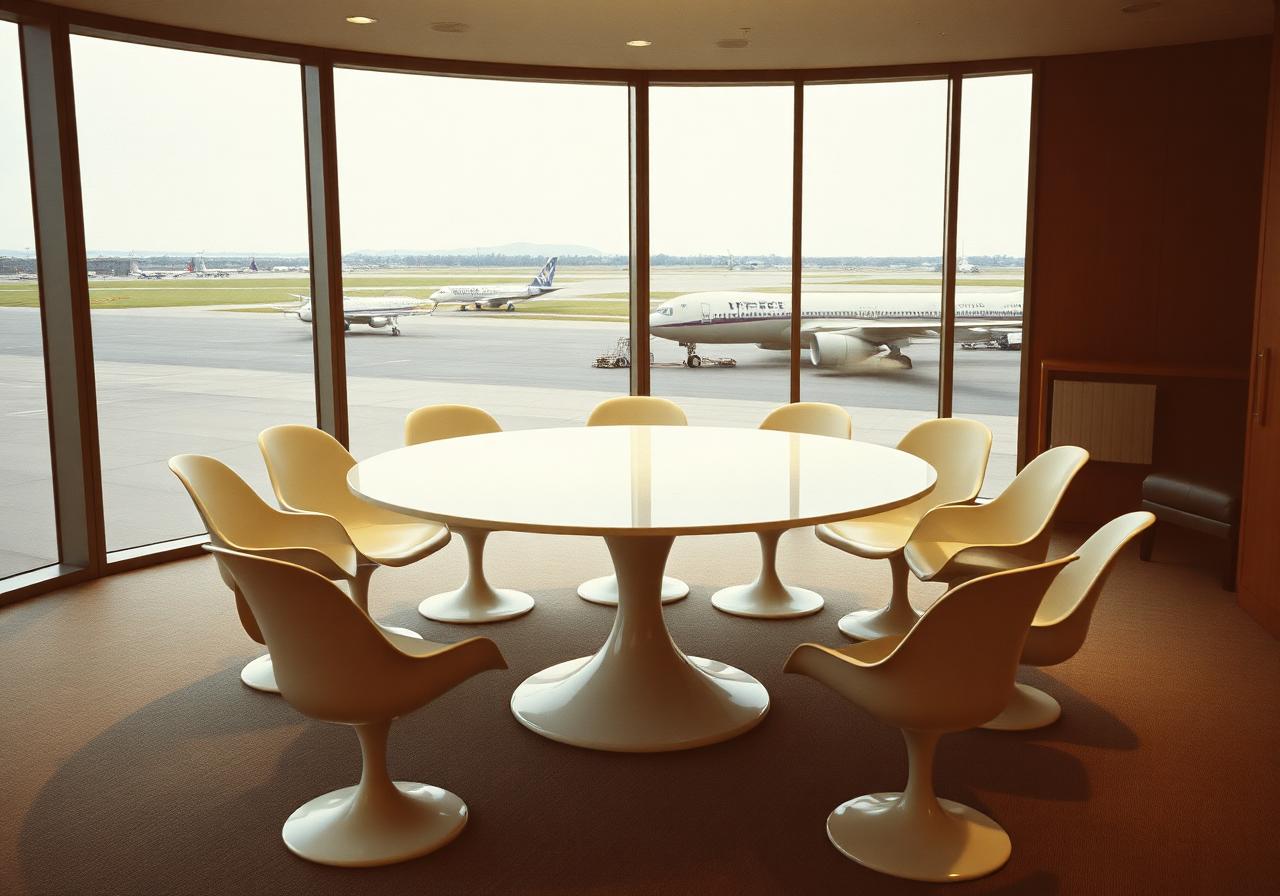
Pan Am's Manhattan boardroom installed an oval Pedestal Table in 1962, surrounded by Tulip armchairs, in deliberate visual reference to the TWA Flight Center then under construction at JFK. The setup became the default airline boardroom dressing for the next two decades; United, Eastern, and Braniff all installed near-identical configurations between 1963 and 1967.
Still cast the same way
Knoll continues to sand-cast the pedestals at the same Pennsylvania foundry it has used since 1957. The marble tops are quarried in Carrara and finished in Italy. A current 54-inch Carrara round retails for approximately $7,200 — and the lead time, from order to delivery, is about the same eighteen weeks it was in 1958.
From the archive
Belongs to the era of
1960s–1970s · Jet Age Modernism →Manufactured by
Knoll →More from the catalogue